In this blog post, City Futures Research Fellow Dr Charlie Gillon shares some reflections on attending the 2025 Computational Urban Planning and Urban Management (CUPUM) Conference, London, 23-27 June 2025 – and invites you to join us at UNSW for CUPUM 2027!
At the end of June, City Futures researchers travelled to London to attend and present at the 2025 Computational Urban Planning and Urban Management (CUPUM) Conference. CUPUM is the premier international conference for research at the intersection of computing technologies, data science, and urban planning, which makes it a key audience for many City Futures research projects. City Futures research projects were presented at CUPUM by myself, Balamurugan Soundararaj, Dick Klostermann, and City Futures Director Chris Pettit, who is the current CUPUM board chair (and has attended every CUPUM meeting since 2003!).
The 2025 edition was hosted by the Bartlett Centre for Advanced Spatial Analysis (CASA) at UCL East in Stratford, a research centre with parallel research interests in city analytics and city planning, and the alma mater for several past and current City Futures staff. This was my first CUPUM conference, and it was an excellent opportunity to introduce our new ARC Discovery project to an international audience. My paper shared our research approach for considering the opportunities and challenges of AI-enabled development assessment, with useful considerations shared by a research audience who are also debating the requirements for trustworthy and responsible AI use. Bala also presented two papers, first showcasing MapAI - an innovative Artificial Intelligence system that uses Generative AI to perform GIS tasks and spatial analysis through natural language, and second on the work led by the Housing Analytics Lab team on applying ML/AI techniques for analysing and classifying planning applications across Australia.
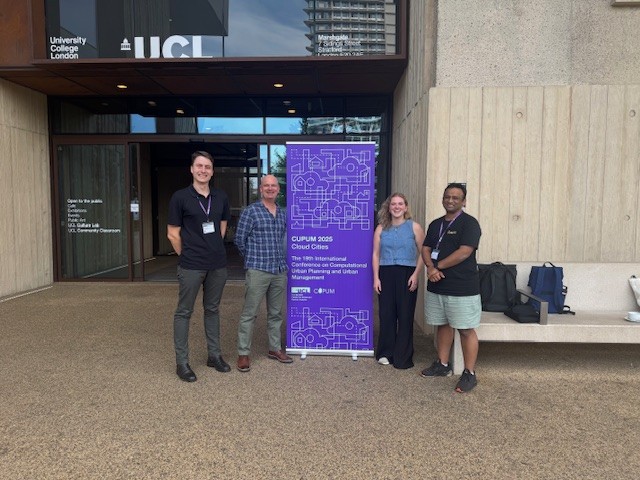
The theme of CUPUM 2025 was 'Cloud Cities', with papers focused on how AI and cloud-based services and technologies are redefining urban planning and urban management. The keynote presentations were highlights and set the scene well: Rob Kitchin sharing a series of critical reflections on framing, method and application for computational urban planning research, Hannah Fry exploring creative uses and applications of AI, and Mike Batty providing a detailed overview of the history and development of AI in urban planning and design. Unsurprisingly AI was a notable focus throughout the conference, with 8 parallel sessions across the three days showcasing research into the design, implementation and use of LLMs and GenAI for urban planning. A key question uniting the papers surrounds the ‘why’ for AI: identifying tasks and processes where AI can deliver benefit; showcasing planning tasks and urban analysis methods already being augmented by AI around the world; and asking how data governance, algorithms and model design can support responsible and trustworthy AI use.
Congratulations to the CUPUM 2025 organisers for a well-run and engaging program of papers and hosting over 400 attendees. For me, attending CUPUM was a great introduction to the research field. I left with new ideas for project framing, some key questions to ask user groups, and a clearer sense of where our project fits within broader disciplinary conversations.
Join us at UNSW for CUPUM 2027!
We’re excited to announce that the next CUPUM conference in 2027 will be hosted by City Futures at UNSW!
Please follow the event page and stay tuned for updates: https://cityfutures.ada.unsw.edu.au/news-event/cupum-2027/.