This short article is part of our '20 high impact research stories' series. This has been assembled to mark two decades of the City Futures Research Centre 2005-2025. Each of the 20 stories revisits an influential research study completed over those 20 years, linking it with related Centre projects and outcomes. A brochure version of all 20 stories will be published later in 2025.

Since its 2011 inception by Prof Hal Pawson and Prof Suzanne Fitzpatrick (Heriot-Watt University, Edinburgh) the Homelessness Monitors series (ongoing in 2025) has generated 30 in-depth reports analysing homelessness problems and solutions in the UK and, latterly, Australia. Prof Pawson has been a contributing or lead author on every one of these 30 publications.
Under the lead authorship of Prof Fitzpatrick and, more recently, Prof Beth Watts (Heriot-Watt University, Edinburgh), UK HM research has been funded by Crisis UK and the Joseph Rowntree Foundation. The resulting reports have become well-known as a source of independent homelessness analysis, highly-respected among government policymakers and in industry circles. Most notably, they have been credited as providing the evidential underpinning for the UK’s Homelessness Reduction Act 2017 that enhanced the legal entitlements of homeless people in England.
UK HM reports have garnered extensive media coverage that has helped to maintain public awareness of the problem and its worsening severity. More importantly, they have been drawn upon by the National Audit Office, Public Accounts Committee, UK Parliamentary Library and others in holding the UK Government to account for its record on homelessness.
Drawing on the UK series, the team’s 2020 journal article ‘The limits of localism: a decade of disaster on homelessness in England’ has garnered over 50 citations.
The project has been shortlisted for research awards by The Guardian, The Times Higher Education Supplement, and The Herald, with Homelessness Monitor England winning ‘Best Housing Research of the Year’ according to a panel of 20 sector experts in both 2021 and 2023.
“The Homelessness Monitor has played an important role in analysing the impact of legislative and policy changes on people experiencing homelessness in Scotland. The Monitor is a key reference point in measuring our progress towards achieving the aims set out in our Ending Homelessness Together action plan. We value the Homelessness Monitor for its balance, clarity and independence”. (Catriona MacKean, Deputy Director for Better Homes, Scottish Government).
“There is no other regular, consistent and thorough analysis of homelessness nationally … I have used the Monitor in several ways across three separate roles … It is always on the essential reading list for my teams, and much anticipated by the sector. At London Councils, we immediately send the link round all 33 boroughs at Housing Director, Head of Housing Need and lead member levels.” (Elly Shepherd, Strategic lead: Housing & Planning, London Councils).
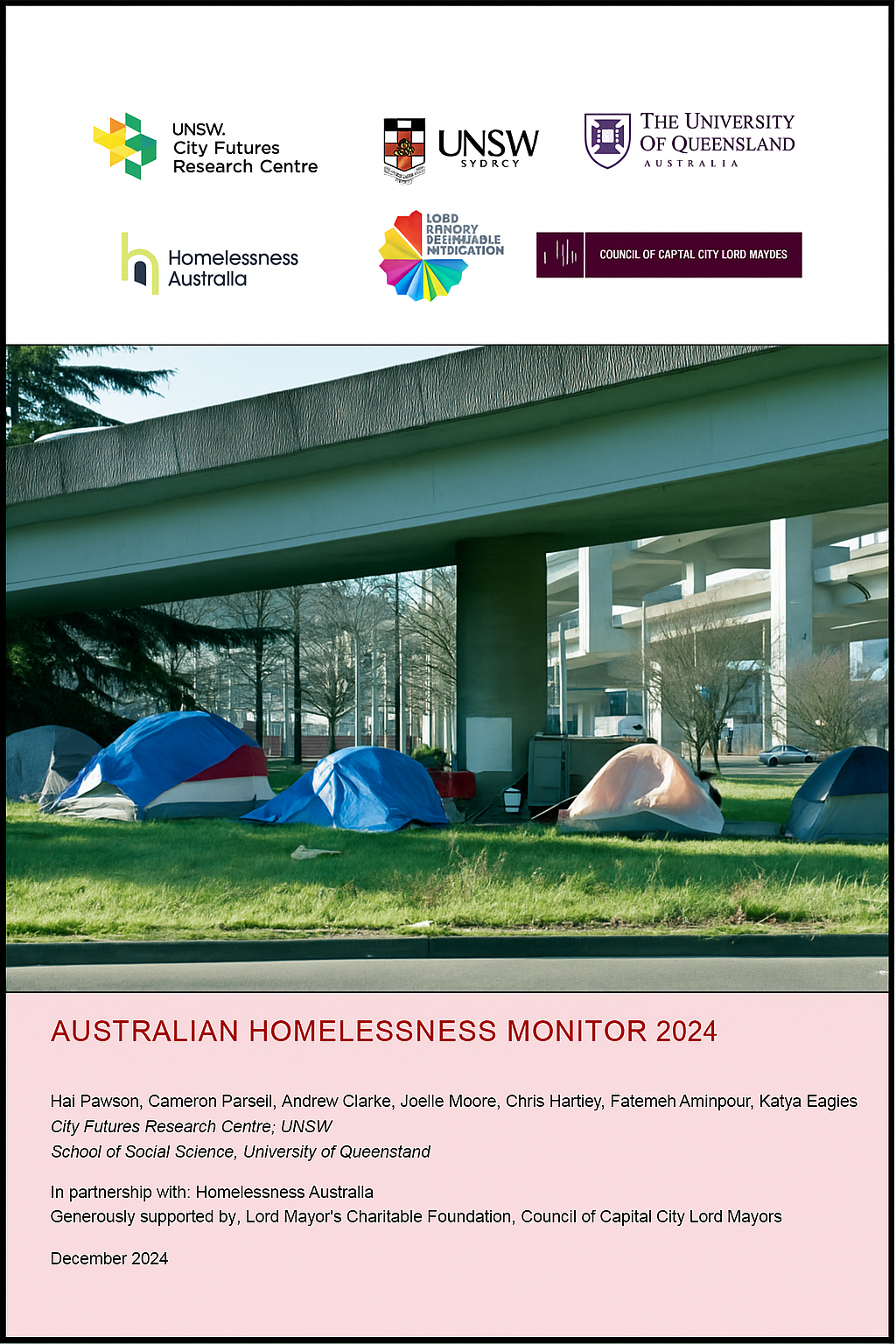
Inspired by the UK HM project, an Australian sister series was launched in 2018 by City Futures researchers. Led by Prof Pawson and also involving Dr Andrew Clark, Chris Hartley, Prof Cameron Parsell (University of Queensland) and others, Australian Homelessness Monitor reports (2018, 2020, 2022 and 2024) have adapted the UK HM model to the Australian administrative and governance context.

Generously funded by the Lord Mayor’s Charitable Foundation (City of Melbourne), and with assistance from industry peak body, Homelessness Australia, the 2024 edition included online surveys of local government authorities and with homelessness services agencies, as well as in-depth interviews with government and non-government stakeholders across Australia.
Also drawing on a novel analysis of official homelessness data, AHM 2024 established that homelessness had continued to escalate in the post-pandemic era, with recent housing market conditions having created a ‘perfect storm’ for support agencies. In parallel with the rising need for crisis assistance, diminishing availability of affordable tenancies had left them experiencing markedly reduced scope to help service users into secure housing.
While documenting a welcome increase in government investment in social housing during the early 2020s that offers the prospect of some limited relief in the next few years, the report noted that none of the underlying spending commitments extends far into the future. As a result it warned of a high risk that this recovery may prove short-lived – therefore offering only short term relief to hard pressed homelessness service agencies and their clients.
Earlier AHM reports have informed CFRC submissions to important Parliamentary Inquiries on homelessness and rental housing.
“For the past few years the Australian Homelessness Monitor series has been providing an invaluable periodic review of homelessness trends and relevant policy developments; building a growing reputation as an independent and authoritative analysis.” (Katherine McKernan, former CEO, Homelessness NSW).
"The Australian Homelessness Monitor provides important analysis of emerging trends in housing and homelessness, and the impact of government interventions. As an independent analysis authored by respected experts, the Monitor lends authority to our advocacy that Australian governments must scale up successful policy to reduce homelessness, and better respond to people without homes." Kate Colvin, CEO, Homelessness Australia.