This short article is part of our '20 high impact research stories' series. This has been assembled to mark two decades of the City Futures Research Centre 2005-2025. Each of the 20 stories revisits an influential research study completed over those 20 years, linking it with related Centre projects and outcomes. A brochure version of all 20 stories will be published later in 2025.
Access to safe, affordable and sustainable housing is the main objective of the National Agreement on Social Housing and Homelessness. Yet for hundreds of thousands of Australians, this basic need remains unmet. As housing costs rise, need for housing support has outpaced policy responses. Accurate evidence on the scale of the challenge and the cost of investment strategies to address it are urgently required to inform action.
A body of research by CFRC tackles this challenge head-on: first, by providing a robust national estimate of unmet need for housing support; and, second, by outlining a cost-effective investment pathway to provide it. Together, they present an evidence base to support a long-term national strategy for social and affordable housing provision.
Unmet housing need: A national snapshot
In a landmark study, Estimating need and costs of social and affordable housing delivery (2019), commissioned by the Community Housing Industry Association, CFRC researchers Dr Laurence Troy, Dr Ryan van den Nouwelant and Professor Bill Randolph delivered a comprehensive estimate of households with unmet housing needs across Australia.
Drawing on the 2016 Census, the report revealed 650,000 social and affordable dwellings were needed. A follow-up report, Quantifying Australia’s unmet housing need: A national snapshot (2022), analysed 2021 Census figures to reveal that the challenge remained unresolved, with 640,000 Australian households living in housing that does not meet their needs. The studies assess challenges experienced by low-income households, specifically those experiencing homelessness, living in overcrowded conditions, or paying more than 30% of income on rent in the private market.
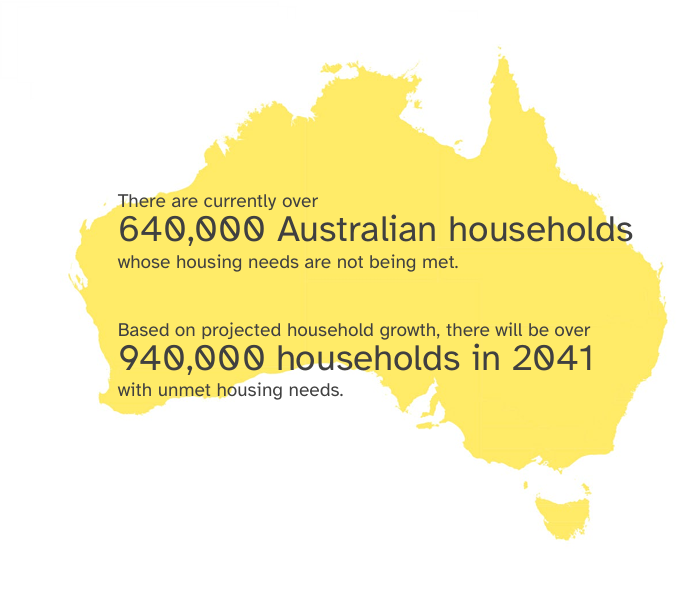
The more recent analysis projects that, without targeted policy intervention, this number will rise to nearly 940,000 households by 2041, representing about one in ten Australian households. It highlights how Australia’s current housing system leaves low-income renters exposed, with estimates suggesting only a third of those in need are currently housed in appropriate social or affordable housing.
To close this gap, the study estimates that average of 47,000 new social and affordable homes would need to be delivered annually over the next two decades, equating to a 6.5% annual growth in non-market housing. As the former CEO of CHIA put:
"This work provided CHIA and its partners, with invaluable data on the scale of need for sub market rental housing in Australia. Before this analysis was carried out the only real option to assess need was the states and territory social housing waiting lists, access to which has been severely rationed. While initially there was some reluctance by governments to accept the scale of need identified in the study, there has been a gradual acceptance and quoting of the figures. It was heartening to read the National Housing Supply and Affordability Council's latest report acknowledging that Australia should be aiming for one in ten of all homes to be social housing —a figure supported by this project."
Making the economic case: Social housing as infrastructure
While the national picture is stark, the research also provides an unprecedented granular breakdown of unmet housing needs, highlighting the highly uneven geography. This granularity enables modelling of delivery and funding options based on regionally-specific market conditions, exploring operating subsidies, capital grants, mixed-tenure developments, and private finance.
In a subsequent report, Costing social and affordable housing delivery across Australia (2023), also commissioned by the Community Housing Industry Association , Dr Troy (now University of Sydney) and Dr van den Nouwelant show that an upfront capital grant model to fund new social and affordable housing, combined with low-interest finance from Housing Australia, is the most cost-effective strategy for government. Meeting the unmet need through such a program equates to a $16k annual subsidy per dwelling for 25 years, less than half the cost of subsidising new private development, which would require nearly $36k per dwelling. Compared to alternatives, the most cost-effective option saves $10-$23 billion over 20 years, while also generating long-term assets and broader public value—economic productivity, social cohesion, and sustainability.

The research built on earlier analysis (2018) conducted as part of a broader AHURI Inquiry that created the economic case for a large-scale investment in social housing. The research adapts the longstanding Canadian ‘core housing need’ model to Australian conditions, and has been used by CFRC researchers as part of AHURI research into unmet housing needs among First Nations households (2025) and, with some adjustments, to quantify housing needs of internally displaced people in Ukraine (2023).
Towards a strategic housing response
Together, these studies offer both diagnosis and prescription: a national framework for quantifying unmet housing need, and a realistic investment pathway to meet it. By combining demographic foresight with fiscal modelling, the City Futures team provides a powerful evidence base for policymakers seeking to close Australia’s housing gap at the scale the crisis demands.