This short article is part of our '20 high impact research stories' series. This has been assembled to mark two decades of the City Futures Research Centre 2005-2025. Each of the 20 stories revisits an influential research study completed over those 20 years, linking it with related Centre projects and outcomes. A brochure version of all 20 stories will be published later in 2025.
Informing housing policy for older Australians
As Australia's population ages, developing responsive housing strategies that reflect the needs and preferences of older Australians has become a pressing policy imperative. Research led by Prof Bruce Judd and colleagues at the City Futures Research Centre has played a pivotal role in informing this agenda, particularly through three influential studies funded by the Australian Housing and Urban Research Institute (AHURI).
Downsizing: Supporting voluntary, planned transitions
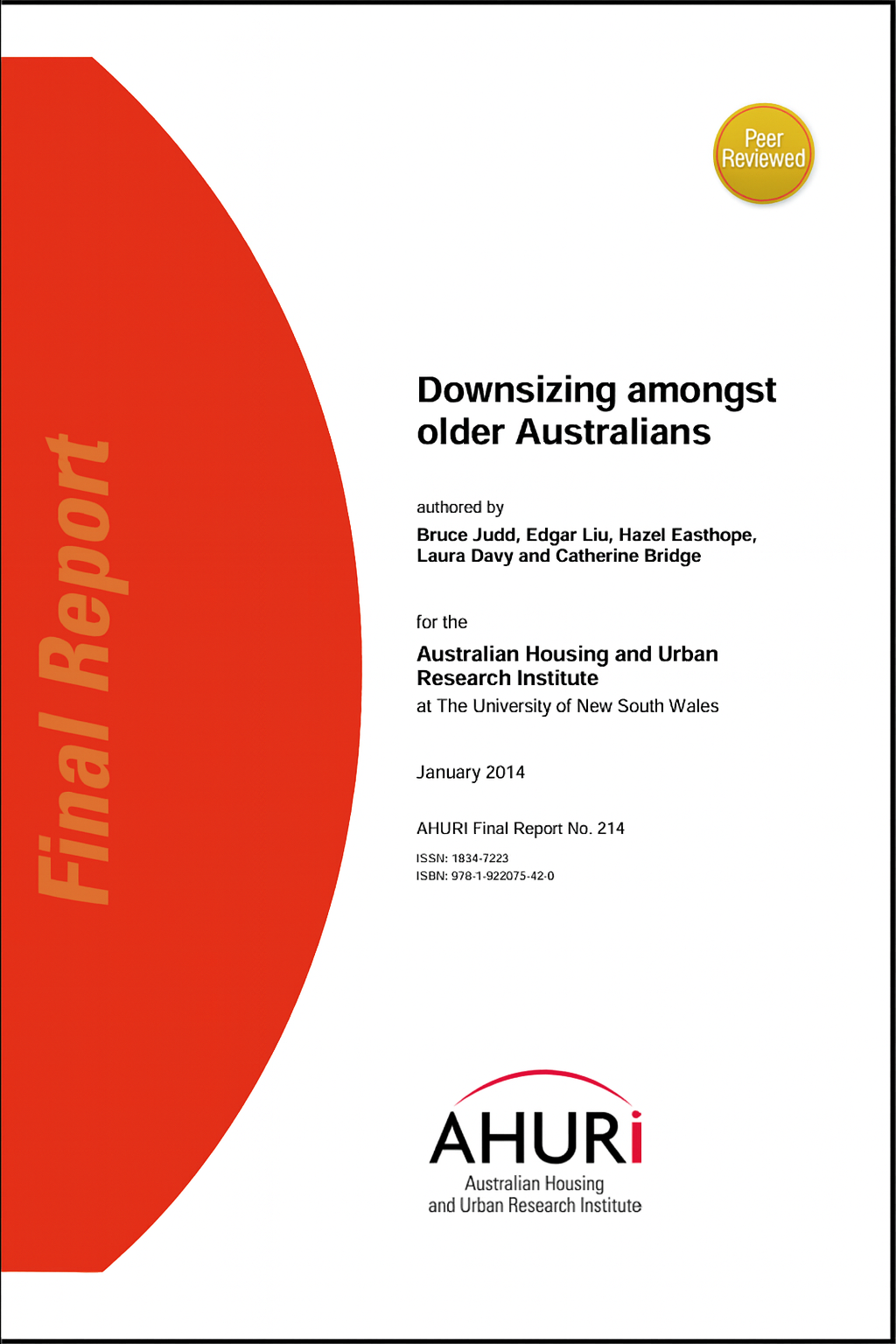
The landmark study, Downsizing among older Australians (2014), challenged the assumption that so-called ‘downsizing’ house moves by older Australians are largely driven by financial motives. Drawing on survey data from over 2,700 respondents and in-depth interviews with 60 participants, the researchers found that 43% of people who moved after the age of 50 had downsized—typically to smaller detached homes or retirement villages—not primarily for economic reasons, for lifestyle change or to reduce the burden of maintaining a large home and garden. Extrapolated to the whole Australian population, of the 18% aged 50+ who had moved within a five-year period, it was estimated that only half (9%) had downsized.
Despite general satisfaction of the survey respondents post-move, the research identified systemic barriers, including a lack of appropriate, age-friendly housing in desirable locations, financial disincentives like stamp duty, and the emotional difficulty of leaving long-term homes. The study identified the importance of “moving sooner rather than later”, emphasising the need for better forward planning, greater availability of advice and support, and housing options that enable ageing in place within existing communities.
Crucially, the research called for a coordinated policy response across four areas:
-
Housing: More age-friendly, appropriately sized homes in familiar neighbourhoods
-
Planning: Supportive urban environments with walkability, access to shops, transport and services
-
Economic policy: Removal of taxation disincentives and support for transition costs
-
Information and support: Improved access to downsizing services and forward planning tools.
Understanding the broader housing landscape for older people
The downsizing research built upon earlier and complementary studies that collectively revealed the diverse housing pathways and needs of older Australians.
In Dwelling, land and neighbourhood use by older home owners (2010), Judd and colleagues responded to debates about housing under-utilisation among older Australians. They found that while most older people occupied large, detached dwellings—84% considered underutilised by conventional metrics—91% of respondents viewed their homes as appropriately sized for their lifestyle. Spare bedrooms were often used for hosting visiting family or pursuing hobbies, and most older people expressed a preference for ageing in place with support, rather than relocating. The study also demonstrated the feasibility of integrating accessible design into mainstream housing. Options evaluated by a cost-benefit analysis—Visitable, Adaptable, and Universal Design—found the 'Visitable' approach to be the most cost-effective for enabling ageing in place. The study also highlighted the role of neighbourhoods: older residents’ ability to participate in social life and live independently was strongly tied to safe, walkable, and well-serviced local environments. This emphasised that appropriate housing must be understood not only in terms of dwelling size but also location, accessibility, and design.

Housing and support for the most vulnerable
While many older Australians are homeowners, a growing number face housing insecurity in later life. Age-specific housing and care for low to moderate income older people (2011) led by Prof Catherine Bridge, explored how rising housing insecurity intersects with gaps in care infrastructure. The research showed that without targeted, affordable, age-appropriate housing integrated with formal and informal care systems, older people with limited resources face compounding disadvantage. It called for cross-sector coordination to deliver housing and care that supports dignity and independence.
Japanese collaboration on ageing and housing
A collaboration with Kyushu University in Fukuoka Japan (2017-18) included a research symposium on Age-friendly Environmental Design and Planning in the Western Asia Pacific leading to publication of the book Ageing in Place: Design, Planning and Policy Response in the Westen Asia-Pacific (2020) edited by Judd, KU Professor Kenichi Tanoue and CRFC’s Doctor Edgar Liu. Professor Ann Forsyth of Harvard University commends it as ‘Tackling an important and growing challenge for countries throughout the world’ by ‘addressing the crucial connections between older people, their homes, and quality of life.’ Building on this collaboration, CFRC researchers Judd and Easthope have continued research with Tanoue on the resident-led renewal of Muromi Danchi, a large, private ownership, early post-war housing estate in Fukuoka with a high proportion of older residents.
Collectively, these studies have deepened our understanding of the diverse needs of older Australians, highlighted the importance of choice, independence and security, and underscored the need for better housing design, location, tenure models, and support systems. Their findings have directly informed national discussions on ageing, housing policy, and the future of inclusive urban development in Australia. As Prof Marianne Abramsson from Stockholm University put:
The City Futures Research Centre has played a major role in the field of research on housing for older adults since its early years, among others through the work of Professor Emeritus Bruce Judd. Researchers from the centre have in particular provided valuable contributions to the European Network for Housing Research and the working group on Housing and Living Conditions of Ageing Populations. The research conducted at CFRC has helped to increase our competence on the living conditions of ageing populations in Australia in particular but in relation to what is taking place in many other countries.