By Hal Pawson and Vivienne Milligan
Today’s Reserve Bank confirmation of unchanged interest rates will disappoint many homeowners counting on another home loan cost saving, widely predicted as recently as last week.
But many economic forecasters continue to expect further mortgage price cuts in 2026, extending the
downward trend of recent months; a trend which has already triggered a fresh pulse of property inflation this year.
And, although such sentiment could be dampened by today’s rate hold, we have recently seen future price hike expectations at their most elevated level for years. For aspiring first home buyers, any small affordability boost from cheaper home loans looks likely to be quickly snuffed out.
All of this suggests that we may be already in the early stages of yet another price rise cycle that may delight existing homeowners, but spells bad news for anyone looking to enter the market in the coming period.
Relative to incomes, Australian house price affordability has indeed declined markedly in the recent past. Back in 2019 a typical property equated to six times the average annual household income. Even by 2024, that ratio had risen to eight – effectively, houses had become more than 30% less affordable in just five years.
Negative long-term trends
But, as laid bare in our new book, the performance of Australia’s housing system has been on the slide for decades. And although hardly unique to this country, powerful statistical evidence demonstrates that, over the long term, the situation has worsened more markedly here than in any major comparator country. Since 1985, Australia’s house price to income ratio has grown by 226%; ahead of Canada (220%), the UK (180%) and the USA (117%).
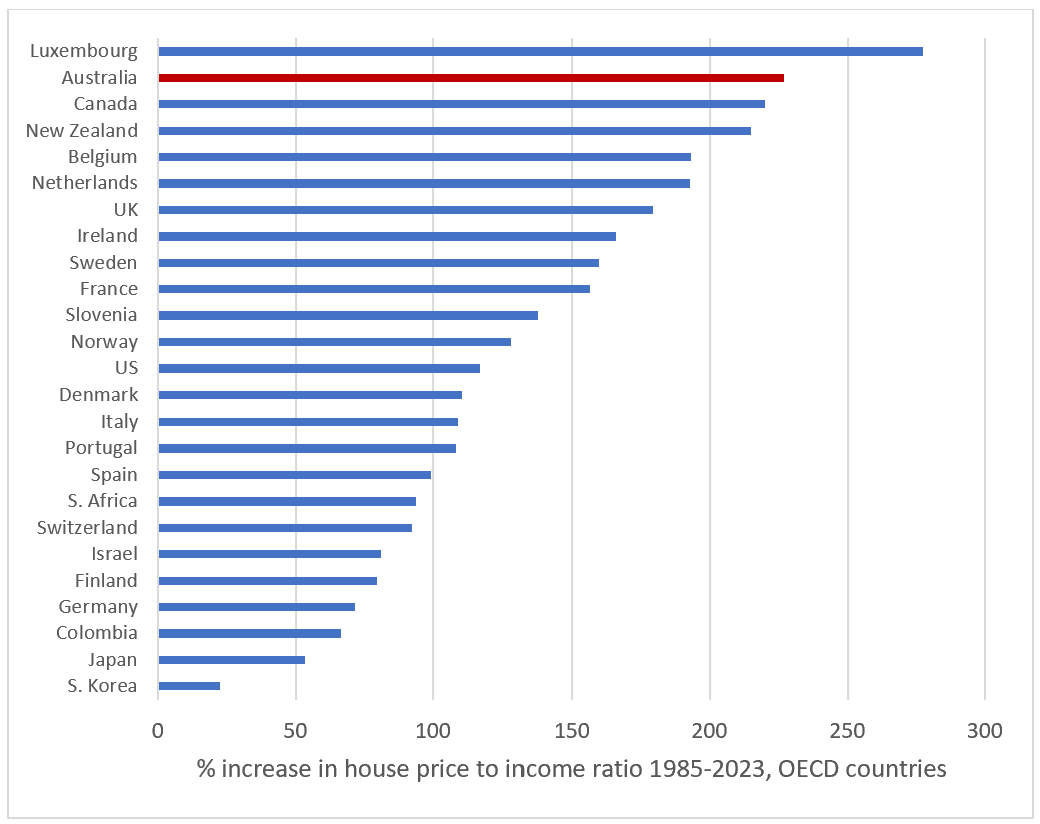
Source of original data: Federal Reserve Bank of Dallas
The increasingly stressed situation lower down Australia’s housing market is also evident in the ongoing upward trend in the national shortfall of private tenancies affordable to low income renters. And in the escalating homelessness numbers that have continued to outpace national population growth.
Australian governments have re-engaged with housing
More positively, though, after a bleak decade of inaction and complacency, the past five years have seen encouraging wide-scale official re-engagement with housing policy challenges, not only at the federal level, but also in most states and territories.
As highlighted and explained in our book, important initiatives have strengthened tenants’ rights, boosted Rent Assistance, revived social and affordable housing construction, and expanded first home buyer assistance. And, under a federally-led process, strenuous efforts to pare back unnecessary planning restrictions and ease approval bottlenecks are ongoing across the country at state/territory level.
However, the scale and breadth of the current ‘housing crisis’, as well as its embedded structural causes, demand much more ambitious and far-reaching actions in coming years.
Generally positive though they may be, recent policy innovations have remained both piecemeal and patchy. Australian governments still lack any coherent roadmap for the deeper reforms needed for transformational change. We do not even know where we are going, nor exactly why. Let alone how we are going to get there.
It is laudable that housing functions have been recently integrated within a single federal department, emulating similar moves in some states. But housing policy settings are and will remain spread across multiple departments, agencies and levels of government. For maximum impact, all must sing from the same song-sheet. A song-sheet that recognises the system complexity and inter-connectedness that make housing an especially challenging policy domain.
Assembling a national housing strategy
For all these reasons we argue that a purposeful housing reform agenda demands the development of a long-term federally-led national housing mission and strategy, underpinned in legislation. Crucially, this should be guided by an overarching commitment to prioritise access to adequate housing as a fundamental human right over the role of housing as a source of private wealth accumulation.
Echoing Jim Chalmers’ recent declaration on the subject, this could be paired with a central dedication to the promotion of inter-generational equity.
Alongside efforts to expand overall housing supply to which Australian governments are already committed, key objectives for the strategy should include:
-
- Preventing homelessness
- Expanding availability of housing affordable to low- and moderate-income earners
- Discouraging speculative investment in land and housing
- Diversifying housing supply towards non-market and build-to-rent products to dampen damaging market volatility
- Enhancing the physical condition of the national housing portfolio; especially on energy performance.
Addressing these issues will necessarily call for an ambitious and wide-ranging plan, whose detailed content will emerge only through its development. However, we argue that it should in any case incorporate new policy directions already commanding wide support among housing economists, policymakers and industry players.
First, it should pledge the phased replacement of stamp duty by broad-based land taxes to spur economic productivity and to encourage more efficient use of the housing stock.
Second, it should define a pathway to phasing down regressive private landlord tax breaks to discourage real estate speculation, with the resulting revenue used to expand social housing investment.
Third, it should advocate the further advancement of tenants’ rights at least to the standards of the leading Australian jurisdictions. Fourth, it should indicate additional measures to support build-to-rent housing development as a contribution to overall supply, and as a form of housing relatively resilient to housing market turbulence.
Fifth, to better match Rent Assistance entitlement to the level of rental stress experienced in different cities and regions, it should pledge the structural reform of this payment.
Especially at the federal level, recent years have seen the foundations laid for significant new directions in housing policy and housing delivery. This has created a rare opportunity to decisively reset Australia’s future housing trajectory in the public interest. It is up to Australian governments to capitalise on this by uniting in support for the kinds of policy changes suggested above. There is no time to waste.
A version of this article originally appeared on John Menadue’s Pearls and Irritations site. Read the original version here.