This short article is part of our '20 high impact research stories' series. This has been assembled to mark two decades of the City Futures Research Centre 2005-2025. Each of the 20 stories revisits an influential research study completed over those 20 years, linking it with related Centre projects and outcomes. A brochure version of all 20 stories will be published later in 2025.
In an era of big data, automation, and rapid urban growth, the ability to accurately and efficiently assess the value of land and property is more critical than ever. Recognising this, CFRC, led by Prof Chris Pettit, has pioneered the development of cutting-edge digital tools and models that revolutionise how property values are calculated, visualised, and applied in planning decisions. These innovations, such as the RAISE Toolkit, the Value Australia project, and the launch of Slate Analytics, shape research and transform policymaking and industry practice. As Prof Pettit explains, “These tools provide a step-change in our ability to inform urban policy with accurate, real-time insights into property market dynamics.”
Rapid Analytics Interactive Scenario Explorer (RAISE)
RAISE is a spatial data toolkit designed to visualise and estimate property value across different scenarios. Developed in collaboration with QUT’s Creative Industries Design Lab and partners including Omnilink and Australian Property Monitors, RAISE allows planners and policymakers to model how infrastructure investments or rezoning could influence land value uplift. By simply dragging and dropping proposed elements like a new train station onto a digital map, users can see in real-time the likely impact on surrounding property values.
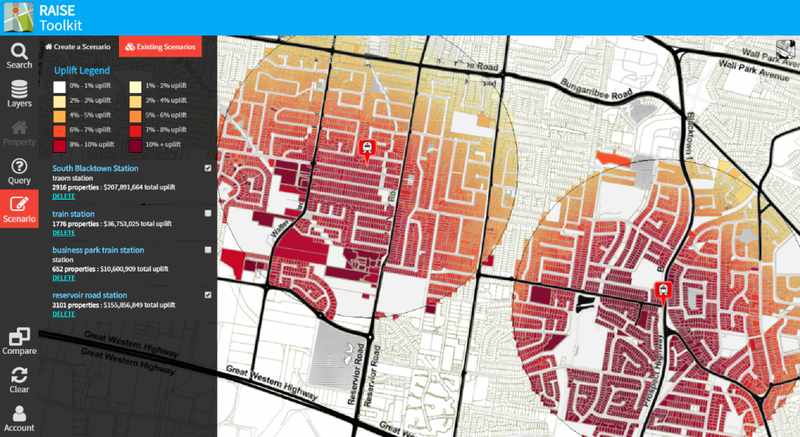
This ability to test infrastructure and zoning scenarios quickly and collaboratively has made RAISE a popular tool among local governments and planning agencies. Pilots in Parramatta and Blacktown tested the tool around proposed light rail and train stations, while agencies such as the Greater Sydney Commission and Landcom have explored its use for precinct development and infrastructure sequencing.
RAISE was recognised with the NSW Planning Excellence Award (2020) and later honoured nationally by the Planning Institute of Australia for its cutting-edge contribution to research and teaching. The tool’s open, cloud-based architecture facilitates collaborative planning, while ongoing development, such as 3D visualisation, promises even greater functionality.
Value Australia: From research to national application
Building on RAISE’s success, the Value Australia project was conceived to scale these innovations nationally. Funded through an Australian Government CRC-P grant and led by FrontierSI in partnership with CFRC, PropertyNSW, the Commonwealth Bank, and others, the project integrates advanced machine learning with enriched datasets to create a national suite of Automated Valuation Models (AVMs).
Value Australia allows users, governments, banks, investors, and developers, to estimate property values in real time, assess the long-term value of infrastructure changes, and model future valuations over extended periods. These tools support Australia’s $6.8 trillion property market by improving valuation accuracy while reducing costs and risk. Given that property tax revenue in Australia amounts to over $50 billion annually, with $300 million spent on valuation services, such digital efficiencies have enormous implications.
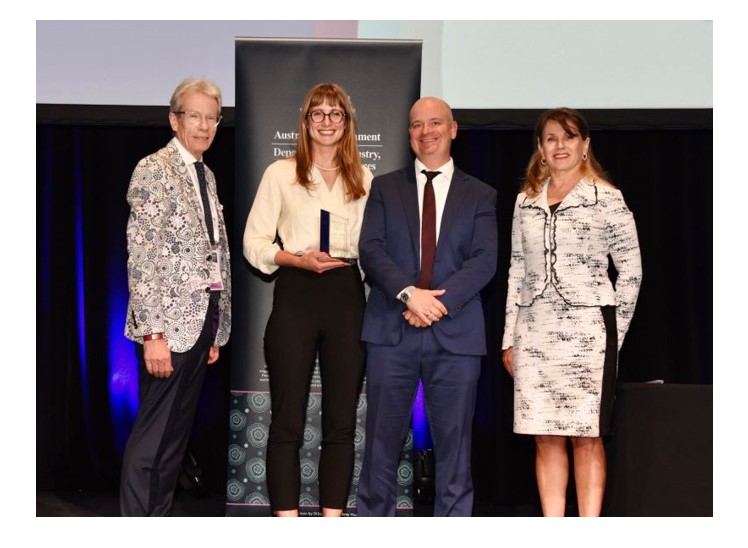
The project also addresses cyber security risks and valuation inconsistencies by developing a secure, scalable digital ecosystem. Its innovations have been recognised with the Asia Pacific Spatial Excellence Award and the 2023 Cooperative Research Australia Award for Research Commercialisation.
Slate Analytics: Commercialising research for greater impact
Recognising the commercial potential of this research, Slate Analytics was launched as a spin-off company jointly founded by FrontierSI and UNSW. With investment from digital conveyancing firm PEXA, Slate Analytics delivers a market-ready version of the RAISE and Value Australia toolkits. It combines big data, spatial analytics, and AI to offer interactive scenario-based valuation tools for planning and development professionals.
Graeme Kernich, CEO of FrontierSI and Director of Slate Analytics, reflected: “Through Slate Analytics, we’ve realised our vision of bringing cutting-edge AI and technology into the property valuation space. It’s a game changer for both the Australian property sector and global markets.”
This move from research to commercialisation aligns with UNSW’s broader strategy to create impact through industry partnerships. By translating complex valuation research into user-friendly digital products, Slate Analytics enhances planning decisions. As Australia’s cities continue to grow and evolve, these tools ensure that planning decisions are informed by evidence.
The development of these digital tools and models has been a collaborative effort involving many staff at the City Futures Research Centre. Key contributors include Professor Chris Pettit, Professor Bill Randolph, Professor Hoon Han, Professor Chyi Lin Lee, Dr Simone Zarpelon Leao, Dr Sarbeswar Praharaj, Dr Ryan van den Nouwelant, Dr Vivien Ye Shi, Dr Qishuo Gao, Dr Yi Lu, Dr Ajith Jayasekare, Dr Matthew Ng, Dr Balamurugan Soundararaj, and Dr Alistair Robson. Their combined expertise has played a critical role in shaping innovative, data-driven solutions for urban planning and research.